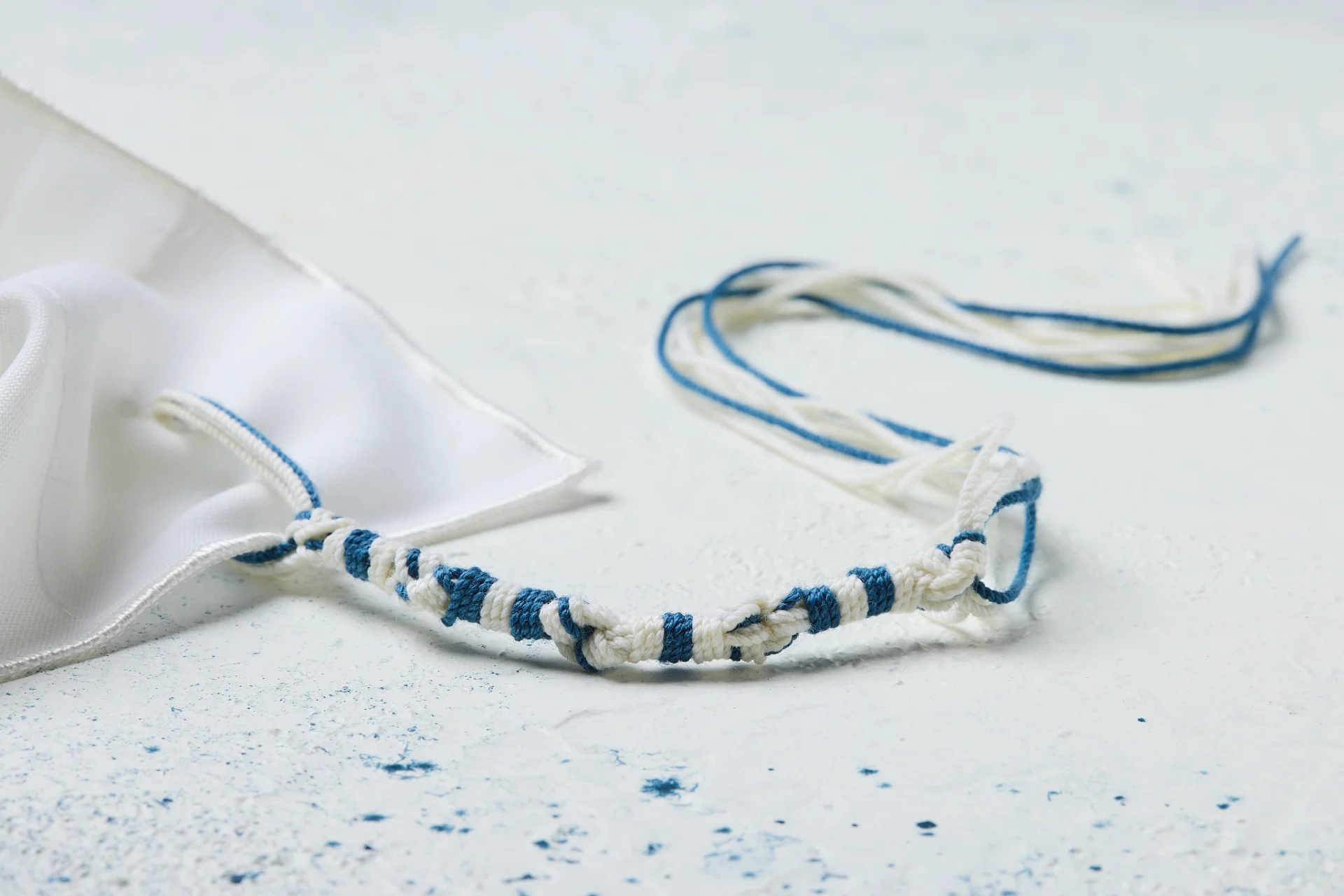
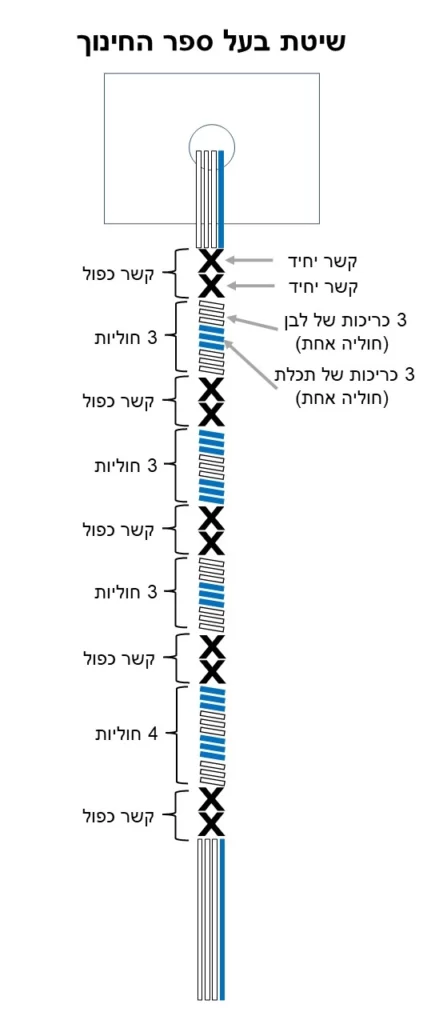
“כיצד עושין הציצית? מעבירין ארבעה חוטין בכנף הבגד, שהן שמונה ראשי חוטין כשהן תלויין בכנף, ואין תולה אותן סמוך ממש לשפת הבגד ולא רחוק, אלא סמוך כשיעור גודל מראשו עד הפרק ראשון, כדאמר רבי יעקב אמר רבי יוחנן בגמרא [מנחות מב, ע”א] ‘וצריך להרחיק כמלוא קשר גודל’. ועושה אחד מהן גדול כדי שיכרוך בו האחרים, וקושרן בחמשה מקומות קשר כפול, ובין קשר וקשר עושה שלש חוליות ובאמצעות הקשר האחרון עושה ארבע חוליות, שנמצאו בין כולן י”ג חוליות.”
“How are the tzitzit made? Four strings are passed through the corner of the garment, so that when they hang from the corner there are eight string-ends. They should not be placed right next to the edge of the garment, nor too far away, but approximately the distance of a thumb-width from the tip of the thumb to its first joint, as Rabbi Yaakov said in the name of Rabbi Yochanan in the Gemara [Menachot 42a]: ‘It is necessary to distance it by the full measure of a thumb-joint.’ One of the strings is made longer so that it can be used to wrap around the others. They are tied in five places with double knots. Between each knot and the next, three chulyot are made, while in the section before the final knot four chulyot are made, for a total of thirteen chulyot.”
Although the Sefer HaChinuch does not explain exactly how the Tekhelet and white are to be combined, it is reasonable to understand that the chulyot themselves alternate between Tekhelet and white. Thus, the first chulya is white, the second is Tekhelet, and so on, until the final chulya, which is again white.
This understanding is based on two instructions in the Gemara: (1) the wrapping should begin with white and end with white, and (2) there must be a visible distinction between one chulya and the next. Since the author of the Sefer HaChinuch writes that there are several chulyot between each pair of knots, but does not explain how those chulyot are distinguished from one another, it can be understood that the distinction is created through the alternating colors.
The alternative would be to say that only the very first and very last wraps are white. If so, some other method would be necessary in order to distinguish one chulya from the next, but no such method is mentioned in the text.
|
Uploaded
Failed
|
 |