How Tekhelet Is Made

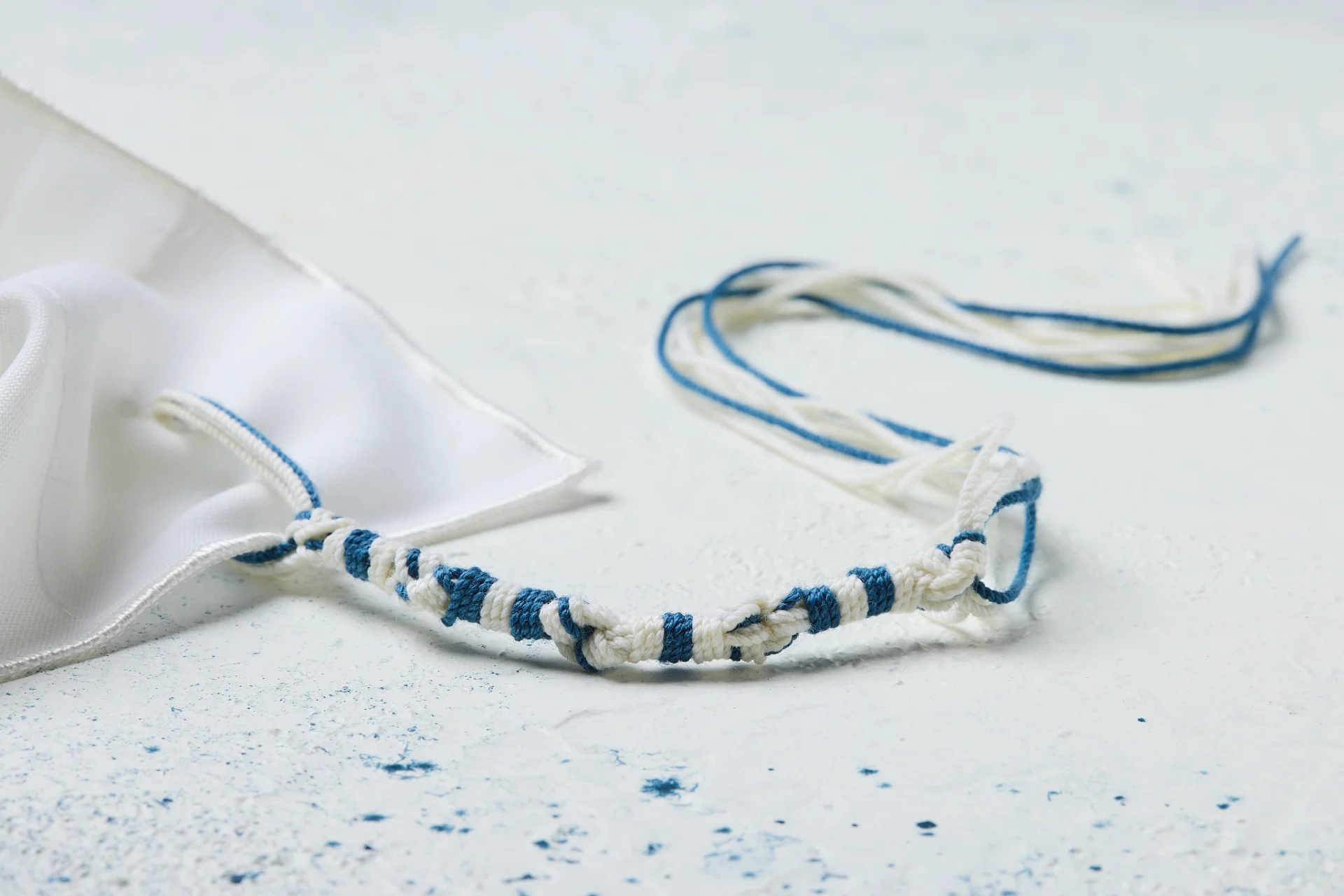
Production of the Tekhelet strings begins with finding the Tekhelet chilazon, goes on through extracting the dye, dyeing the wool, spinning it into threads and plying them into strings.
How does it happen? Scroll down and take a look at the process!

1

Trapping the Chilazon

The Tekhelet chilazon, the Murex trunculus, lives on the floor of the Mediterranean Sea.
Its color and shape make it almost invisible, just as the Gemara says: "the body of the chilazon resembles the sea".
To catch the snails, the chilazon hunters lower net baskets filled with bait. After a while the hunters collect the baskets with the snails caught in them.
This method is ancient and is already mentioned in the Gemara and in other sources.
Even today, many hundreds of years after the era of the Gemara, the chilazon hunters still use exactly the same hunting methods to catch the Tekhelet snails, and the snails we use to produce the Tekhelet come from places where they are caught for food.

2

Extracting the Tekhelet

Like the chilazon itself, the chilazon's dye gland is also found in a hidden place.
To reach it, the shell of the chilazon is cracked open at a particular point and the gland is removed. The glands that have been collected we lay out to dry in the sun, and afterwards we use the dried dye powder for dyeing.
This stage is carried out under supervision, in order to verify that all the glands come from Murex trunculus snails alone, as was also done in the past, and as the Gemara says: "Tekhelet may be bought only from an expert" — that is, a trustworthy person who is an expert in dyeing with Tekhelet. This is because Tekhelet can be counterfeited, and a Tekhelet substitute can be produced from a plant source, "kala ilan" in the language of the Gemara, which is almost impossible to distinguish from genuine Tekhelet.
We keep the dye powder under doubled and redoubled supervision until it reaches our workshop.
3

Spinning the Wool

We make the tzitzit strings from pure sheep's wool.
To turn the wool fibers into strings, the wool has to go through two main stages: spinning and plying.
In the spinning stage, the natural wool fibers are turned into threads using a spindle or distaff. Spinning is done by twisting the wool fibers around themselves until they become one long, fine thread.
The spinning is done "lishmah", for the sake of the mitzvah of tzitzit.
The wool arrives at our workshop already spun — after it has been sheared, washed, combed and spun — so that it is ready for the next stage: dyeing.

4

Dyeing the Wool

At this stage we dye the spun threads using the dye extracted from the Tekhelet chilazon.
We boil the wool threads in a vat (a large pot) containing the dye powder from the chilazon together with various reducing agents, exactly as described in the Gemara. These agents allow the dye to be absorbed into the wool in a process called oxidation-reduction, which bonds the dye molecule very strongly to the wool fibers. During the dyeing we expose the wool to light, in order to obtain threads of a sky-blue Tekhelet color.
Once the wool threads have absorbed the dye, we rinse them and put them out to dry in the open air, and then they are ready for the next stage: plying.

5

Plying the Strings

In the plying stage, the fine threads become strings.
The workshop's craftsmen arrange eight spools of Tekhelet-dyed thread on a special plying machine, operated by hand only and "lishmah", for the sake of the mitzvah of tzitzit. The machine is built so that it can be moved back and forth along a rail while the threads are twisted around themselves. All the threads are plied together until Tekhelet strings are formed.
At the end of this intricate process two kinds of strings emerge: those dyed entirely in Tekhelet, according to the method of the Raavad and Tosafot, and those dyed only halfway, according to the method of the Rambam. We cut the long strings to size in order to produce strings suited to the various tying methods.

Gallery from the Production Process

שַׁבַּת הַתְּכֵלֶת
Shabbat HaTekhelet — marking Parashat Shelach, in which the mitzvah of tzitzit and Tekhelet was given to Am Yisrael,

“Ptil Tekhelet” is running a special, one-of-a-kind offer!
Buy a cotton tallit katan with Tekhelet strings and pay for the strings alone!
(For a wool tallit katan, just add ₪50!)